Dominic Abata
I Heard You Paint HousesDominic Abata was the rebel leader in a 1961 Chicago union struggle over Teamsters Local 777, a taxicab local controlled by Joey Glimco. The book presents him through Frank Sheeran’s recollections: first as the organizer whose campaign threatened Glimco’s network, then as the man who faced Sheeran during an attempted show of force, and finally as the victor of the local’s election. Abata’s importance lies not in a detailed personal history, which the account does not provide, but in the way his bid for independence turned a labor dispute into a contest of intimidation, institutional power, and public violence.
The Local 777 Challenge
Abata had gathered enough signatures from dissident members to bring Local 777’s future to an election. The rebels wanted the Chicago cab local to become independent of the Teamsters; Paul Hall’s Seafarers Union, affiliated with the AFL-CIO, was backing them and expected to take over the local if they won. The dispute thus joined a rank-and-file challenge to Glimco’s control with a larger contest between unions for jurisdiction and influence.
Glimco’s stake extended beyond one cab local. Sheeran describes him as controlling fifteen Chicago cab locals outright, as well as Teamsters locals in other trades and other unions behind the scenes. In that setting, allowing Local 777 to leave without resistance risked setting an example for the rest of Glimco’s organization. Sheeran says Glimco wanted the rebels’ departure to be painful enough to warn other locals to remain in line. The account acknowledges that the cab drivers had reasons for wanting out, while emphasizing how the breadth of Glimco’s holdings made their campaign a threat to a much larger network.
The Attempted Warning
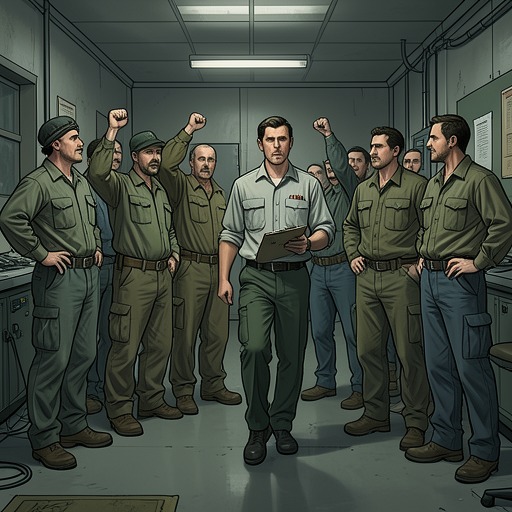
Before Abata received round-the-clock police protection, Glimco’s scouts reported that he was at a particular location with two of his men. Glimco sent Sheeran to give him a message, a phrase Sheeran explains as an order for a physical beating rather than a shooting. Sheeran went with two men from Philadelphia whom Jimmy Hoffa had sent to Chicago. They walked past a chain-link fence toward a cinder-block building, where about fifty men suddenly emerged. Sheeran’s two companions ran; Sheeran stayed where he was.
Sheeran recalled warning the crowd that if they came after him, they had better kill him, because otherwise he would return and kill them. Abata met his eyes and said that they knew who Sheeran was. Sheeran then offered to fight Abata’s two best men at once, perhaps three, though he doubted he could manage that many. Abata let him leave, acknowledging his nerve while advising him to choose his company better next time. The scene does not show Abata ordering an attack: instead, it records him confronting a show of force with enough composure to end the encounter without a fight. Sheeran later complained to Glimco that he should have been told how many men he was expected to face, comparing the misjudgment to a patrol being sent against a squad only to meet a full regiment.
From Intimidation to Election
The pressure on the rebel cab drivers continued through attacks on their livelihoods. Sheeran describes cabs bearing rebel or Seafarers signs being stolen from stands and driven into Lake Michigan, with the stated purpose of cutting the dissidents’ revenue. He also recounts a planned confrontation outside the Hamilton Hotel. After Hall gave the rebels a Seafarers charter, Hall and Abata were celebrating inside when Glimco arranged an informational picket line outside. A Teamster went into the cocktail lounge, shouted insults at them, and struck a police officer who told him to leave. When officers brought him outside, Abata and Hall followed; Glimco’s men then attacked the officers, Hall, and Abata. The account presents the disturbance as a deliberate effort to draw the two leaders out of the hotel, where the confrontation could be staged in public.
Despite the attempted intimidation and the competition between the unions, Abata’s rebels won the Local 777 election in Chicago in the summer of 1961. Hall subsequently gave the local a Seafarers charter, making the successful breakaway part of the AFL-CIO. The outcome reversed Glimco’s effort to make departure a warning to other locals: the dissidents’ campaign became an actual transfer of union allegiance. Jimmy Hoffa regarded the larger contest with Hall as open warfare, though Sheeran’s account places responsibility for the escalation across the rival organizations rather than solely on Abata.
A Figure Seen Through Conflict
Abata appears only within Sheeran’s retrospective account of the Chicago labor fight. The narrative offers no independent account of his background or private aims; it identifies him by his organizing role, the signed cards that enabled an election, his confrontation with Sheeran, and his leadership of the winning dissidents. This limited perspective makes him a political opponent in a story chiefly concerned with the Teamsters’ response to a challenge from within its ranks.
Yet the details distinguish Abata from a passive symbol of that challenge. He was present with other men before police protection was arranged, faced Sheeran when a large crowd gathered, and spoke directly to him before allowing him to go. Later, he stood with Hall at the hotel as Glimco’s plan brought the leaders into the street and into an assault. His consequential action, however, was the organizing effort that culminated in the election. The contrast between the crowd’s threatened force and the rebels’ eventual institutional victory gives his brief appearance its shape: the local’s independence was contested physically, but it was decided through the ballot that Glimco’s campaign had been meant to prevent.